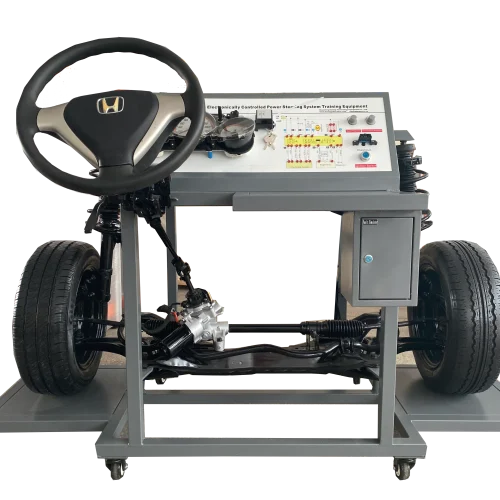
I. Overview
1. The test bench is based on the actual Toyota Corolla electric power steering system and is equipped with an electronic control system test panel, enabling realistic operation of the electric power steering system. This allows for practical training on the system’s structure, operating principles, system diagnosis, and fault assessment.
II. Equipment Components
1. The training bench includes the following key components: ① 2 lower control arms; ② 1 mobile stand; ③ 1 steering wheel assembly; ④ 2 tires; ⑤ 1 battery; ⑥ 1 steering gear assembly; ⑦ 1 steering gear assembly; ⑧ 2 clevises.
III. Functional Description
1. Based on the original electronic power steering system, this system is equipped with all relevant auxiliary control systems. All sensors and actuators are fully functional, ensuring the normal operation of the electronic power steering system. This makes it suitable for conducting various operating condition experiments on the electronic power steering system. It effectively reflects the electronic power steering response to various parameters such as vehicle speed, steering resistance, steering angle, and steering speed.
2. It can conduct clear comparative experiments with and without power steering. By adjusting the simulated steering resistance loading device, it can reflect the various steering parameter changes caused by different steering resistance changes during actual driving.
3. The wiring harness terminals are marked with a wire marking machine for ease of teaching. The wires are neatly arranged and concealed, and the wiring harness is securely fixed on the back of the panel and inside the test bench.
4. By simulating the vehicle speed, it realistically reflects the operation of the power control solenoid valve during computer-controlled high-speed driving, thereby helping students understand the concept of electronic power steering. Optimal steering assist distribution (reduced assist at high speeds for greater vehicle stability);
5. Color-coded structural diagrams of each system component and circuit schematics facilitate students’ understanding of circuits and electronic control principles by comparing them to real objects, allowing them to directly measure and analyze signal parameters such as voltage, resistance, current, and frequency in related circuits on the panel;
6. Equipped with an OBD-II diagnostic socket, a dedicated decoder allows students to perform practical training on electric power steering control systems, including reading and clearing fault codes, reading data streams, and analyzing waveforms;
7. The training platform is equipped with real vehicle faults. The instructor sets the faults, and students analyze and locate the fault points, while also mastering real vehicle troubleshooting skills;
8. The training platform is constructed of high-strength European standard aluminum profiles and decorated with anti-collision rubber strips, making it durable and attractive. It is equipped with four swivel casters with self-locking mechanisms for secure positioning. IV. Technical Features
1. Stand Dimensions: ≥ 1400 mm (L) × 700 mm (W) × 1300 mm (H)
2. Frame Material: Sheet metal with electrostatic spraying
3. Main Panel Material: Aluminum-plastic composite panel (weather-resistant, wear-resistant, high-temperature resistant, high-strength, and corrosion-resistant)
4. System Circuit Diagram Printing Method: UV Printing (The system circuit diagram is drawn and assembled in accordance with the original manufacturer’s repair manual).
5. Side Panel Material: Aluminum-plastic composite panel (weather-resistant, corrosion-resistant, high-strength, and high-temperature resistant)
6. Test Ports: High-quality nylon material, high-pressure safety, 4mm panel banana sockets / PA66 high-strength nylon / brass nickel-plated / RoHS-compliant electroplating
7. Load-bearing Wheels: Made of a single-piece composite nylon material, they offer high load-bearing capacity and high wear resistance. The wide wheel tread provides exceptional stability, flexible rotation, and superior durability. The dual-bearing design ensures even load bearing and is pressure- and impact-resistant. V. Practical Training
1. Comparative training on automotive power steering and non-power steering;
2. Cognitive training on the operating principle of an automotive electronic power steering system;
3. Disassembly and inspection of an automotive electronic power steering system;
4. Mastering troubleshooting methods based on the symptoms;
5. Understanding the location, types, and performance of various sensors and actuators;
6. Inspection of steering column lock, tilt, and collapse functions;
7. Measurement of steering free play;
8. Disassembly and assembly of the steering column assembly;
9. Testing of the electronic steering torque and angle sensors.