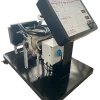
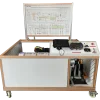
I. Overview
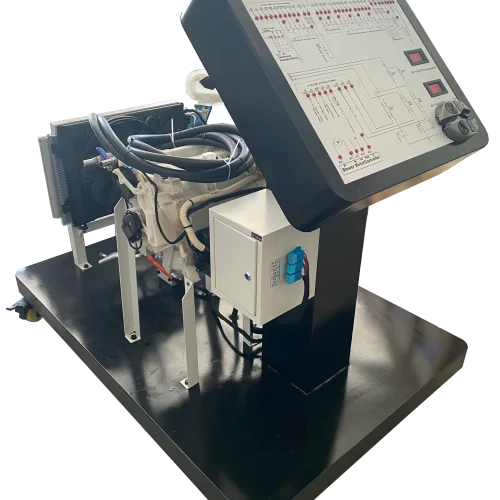
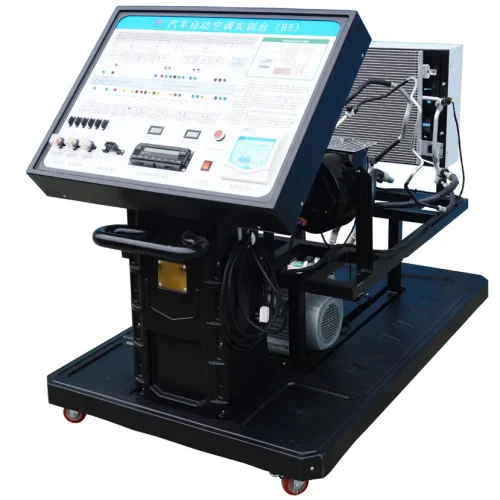
1. The training bench uses an authentic BYD e5 air conditioning and heating system. It realistically demonstrates the connection and control relationships, installation locations, and operating parameters between the core components of the BYD e5’s air conditioning and heating systems. This helps trainees develop their ability to analyze and troubleshoot BYD e5 air conditioning and heating system faults. This bench is suitable for teaching new energy pure electric vehicle courses and maintenance training at vocational and technical colleges.
II. Equipment Components
1. The training bench includes the following key components: ① Air conditioning PTC heating assembly (1); ② Mobile stand (1); ③ Electric air conditioning compressor (1); ④ CD player assembly (1); ⑤ Speakers (2); ⑥ Outdoor temperature sensor (1); ⑦ Electronic expansion valve (1 set); ⑧ Refrigerator assembly (1 set); ⑨ Pressure sensor (1).
III. Functional Description
1. Air conditioning refrigeration system: An electric compressor driven by the air conditioner driver extracts gaseous refrigerant from the evaporator and presses it into the condenser. The high-pressure gaseous refrigerant liquefies as it passes through the condenser, exchanging heat (releasing heat), which is then carried away by the outside air. The high-pressure liquid refrigerant is reduced in pressure by the throttling action of the expansion valve. The low-pressure liquid refrigerant vaporizes in the evaporator, absorbing heat and exchanging heat. The cooled air near the evaporator is then drawn into the vehicle cabin by a blower. The gaseous refrigerant is then extracted by the compressor and pumped into the condenser, creating a closed refrigerant circulation system that continuously dissipates heat from the cabin to the outside, lowering the cabin temperature to a comfortable level.
2. Heating System: The heating system uses a PTC water heater assembly to heat the coolant. The coolant is first pumped from the air conditioner heater sub-tank assembly by a water pump and then pumped into the PTC water heater assembly. The heated coolant then flows through the heater core and returns to the air conditioner heater sub-tank assembly, repeating the cycle.
3. All major components are mounted on a platform, and the electrical connections are identical to those in the actual vehicle. Disassembly is easy after power is disconnected, allowing trainees to master the key points of disassembly and assembly of air conditioner and heater system components during the disassembly and connection process. 4. This training platform is connected to the pure electric vehicle electric drive system training platform. The connecting cables are the same as the original vehicle and are connected in the same manner as the original vehicle. Power is supplied by the pure electric vehicle power battery and management system training platform.
5. The teaching board displays the complete operating schematics of the air conditioning and heating systems and is equipped with test terminals. Using a multimeter and oscilloscope, parameter changes under various conditions can be monitored in real time.
6. The training platform features a test station equipped with 4mm red and black test terminals, allowing students to simultaneously measure electrical signals such as voltage, resistance, and frequency.
7. The training platform’s test panel is silk-screened with the electric air conditioning system circuit schematic. The panel is made of aluminum-plastic composite material. The test terminal names are silk-screened in color and labeled with numbers corresponding to the circuit connections on the schematic. 8. The measurement panel can detect: IG1 power supply, air conditioning water pump main power, pressure sensor signal, pressure sensor power supply, air conditioning subnet CANH, air conditioning subnet CANL, electronic expansion valve control terminal A, electronic expansion valve control terminal B, pressure and temperature sensor power supply, temperature signal, pressure signal, blower speed control signal, blower power supply, evaporator temperature sensor ground, evaporator temperature sensor power supply, mode motor feedback, heating and cooling motor signals, and other signals.
9. The stand columns utilize an integrated, all-plastic, high-strength ABS, fully molded, snap-on base, manufactured in strict accordance with electrical certification standards. The exterior is oil-resistant, corrosion-resistant, and easy to clean, eliminating the paint peeling that occurs with traditional steel frames after plastic spraying. The entire system offers exceptional safety and reliability.
10. The training platform is equipped with an intelligent touchscreen fault setting and assessment system, which includes fault information for the air conditioning pressure sensor signal, internal and external circulation motor, heating and cooling circulation motor, outlet mode circulation motor, front evaporator temperature sensor, outdoor temperature sensor, indoor temperature sensor, and pressure and temperature sensor, facilitating intelligent teaching. IV. Technical Features
1. Stand Dimensions: ≥ 1400 mm (L) × 900 mm (W) × 1350 mm (H)
2. Frame Material: European standard industrial aluminum profile / matte oxidized finish
3. Main Panel Material: Aluminum-plastic composite panel (weather-resistant, wear-resistant, high-temperature resistant, high-strength, and corrosion-resistant)
4. System Circuit Diagram Printing Method: UV printing (the system circuit diagram is drawn and assembled in accordance with the original factory maintenance manual).
5. Side Panel Material: Aluminum-plastic composite panel (weather-resistant, corrosion-resistant, high-strength, and high-temperature resistant)
6. Test Ports: High-quality nylon material, high-pressure safety, 4mm panel banana jack / PA66 high-strength nylon / brass nickel-plated / RoHS-compliant electroplating
7. Load-bearing Wheels: Made of a single-piece composite nylon material, they offer high load-bearing capacity and high wear resistance. The wide wheel tread provides exceptional stability, flexible rotation, and superior durability. The dual-bearing design ensures even load bearing and is pressure- and impact-resistant. V. Practical Training Projects
1. Understand the operating principles of pure electric vehicle air conditioning and refrigeration.
2. Understand the functions of the main components of pure electric vehicle air conditioning and refrigeration.
3. Understand the differences between pure electric vehicle air conditioning and refrigeration and those of traditional vehicles.
4. Understand the operating principles of pure electric vehicle heater modules.
5. Understand the functions of the main components of pure electric vehicle heater modules.
6. Understand the differences between pure electric vehicle heater modules and those of traditional vehicles.
7. Familiarize yourself with refrigerant discharge, evacuation, and refilling.
8. Understand the disassembly, assembly, and connection of piping.
9. Familiarize yourself with high and low pressure detection and fault diagnosis of air conditioning systems.