I. Overview
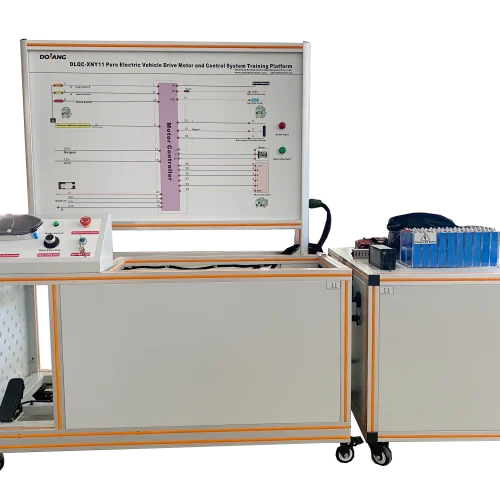
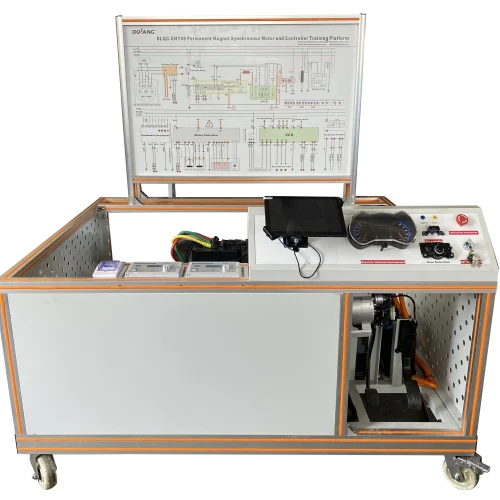
1. The training platform uses a pure electric vehicle battery pack with a rated capacity ≥ 75AH, a nominal voltage ≥ 633.6V, and a rated energy ≥ 47.5KWh. It consists of a battery management controller (BMC), 13 battery information collectors (BICs), and a power battery sampling line. The power battery uses night cooling and a PTC heating system to regulate temperature. The platform realistically demonstrates the connection and control relationships, installation locations, and operating parameters of the core components of the lithium iron phosphate power battery pack. The training platform uses BYD E5 pure electric vehicle components, with functions and control methods identical to those of general-purpose pure electric vehicles. This realistically demonstrates the connection and control relationships, installation locations, and operating parameters of the core components of the new energy electric drive system, and cultivates students’ ability to analyze and troubleshoot new energy electric drive system faults, thereby providing instruction on power batteries and management systems. II. Functional Description
1. This product utilizes the original vehicle’s permanent magnet AC synchronous motor with a rated power ≥ 80 kW, peak power ≥ 160 kW, maximum torque ≥ 310 N·m, and a top speed ≥ 130 km/h. The transmission uses the original vehicle’s single-speed fixed-ratio transmission, with front-engine, front-wheel drive.
2. It is equipped with a push-button start switch, electronic parking switch, accelerator pedal, brake pedal, shift module, electric vacuum assist system, and original vehicle instrumentation to simulate various vehicle operating conditions. Protective devices are installed on the motor-driven wheels.
3. The training platform is equipped with an independent cooling circulation system consisting of an electronic water pump, motor, radiator, radiator, and electronic fan. It also features the original vehicle’s electric vacuum pump for high braking stability, driven by a 12V DC power supply.
4. The high-voltage electronic control assembly utilizes BYD’s latest electronic control technology, including a motor controller module, onboard charger module, DC-DC converter module, high-voltage power distribution module, and leakage detection module. 5. The teaching platform is equipped with both DC fast charging and AC charging ports. The AC charging port supports AC 220VAC/7kW slow charging but does not support 380V AC charging. Ensure a secure ground connection.
6. The battery pack has a nominal voltage ≥ 633.6V, a capacity ≥ 75AH (47.5kWh), a single cell ≥ 3.2V/75AH, and 198 cells connected in series. The battery pack supports a pure electric range of 305km for the original vehicle. It utilizes a distributed battery management system consisting of a battery management controller (BMC), 13 battery information collectors (BICs), and a power battery sampling cable.
7. The main functions of the battery management controller include charge and discharge management, contactor control, power control, battery abnormality alarm and protection, SOC/SOH calculation, self-test, and communication. The main functions of the battery information collector include battery voltage sampling, temperature sampling, cell balancing, and sampling line abnormality detection. The main function of the power battery sampling cable is to connect the battery management controller and battery information collector, enabling communication and information exchange between them. 8. Transparent modifications, without changing the original vehicle layout, facilitate understanding of the battery structure while strictly prohibiting contact to ensure safe learning. Both the low-voltage control and high-voltage power lines are original vehicle components. The high-voltage power line is orange and features protective bellows. Warning signs are placed at the connections. Plugging or unplugging any high-voltage power line while the power is on is strictly prohibited. This helps students quickly understand the components and connections of the power battery.
9. The training bench features a test station equipped with 4mm red and black test terminals, allowing students to simultaneously measure electrical signals such as voltage, resistance, and frequency.
10. The training bench features fault indicators for the negative contactor control pin, voltage divider contactor, battery subnet CAN-L, and high-voltage interlock signal input, facilitating intelligent teaching.
11. The power battery pack is semi-transparent, allowing students to observe the internal structure of the battery.